Home Blog Financial Advisor Scenario Analysis

How Financial Advisors Use Scenario Analysis to Guide Clients

Markets don’t move in a straight line. Interest rates shift, inflation rises and falls, and equity markets can swing sharply within short periods. For investors, this creates a constant layer of uncertainty; returns are never guaranteed, and outcomes rarely follow a single predictable path.

The real challenge is this: most investors don’t know how to answer a simple but critical question: what happens if things don’t go as expected? What if markets underperform for a few years? What if inflation stays high? What if returns exceed expectations? Without a structured way to think through these possibilities, decision-making becomes reactive rather than strategic.

This is where scenario analysis becomes more helpful for distributors. Instead of trying to predict a single “correct” outcome, scenario analysis helps evaluate multiple possible futures, including the best-case, worst-case, and most-likely case. It shifts the focus from guessing to preparing.

In finance, scenario analysis is not about forecasting the market with certainty. It is a disciplined decision-making framework that enables investors and financial advisors to plan, adapt, and stay aligned with their long-term goals, regardless of market conditions.

What Is Scenario Analysis?

Scenario analysis is a simple way to understand how your investments can perform in different market conditions. Instead of assuming one fixed return, it looks at multiple possibilities like a good market, average market, and bad market to show what can actually happen.

If you’re wondering what scenario analysis is, it is essentially a “what if” approach:

  • What if markets go up?
  • What if markets stay flat?
  • What if markets fall?

This helps you and your clients stay prepared instead of surprised.

In financial scenario analysis, advisors use this method to assess how changes in returns, inflation, or interest rates can affect a client’s portfolio or goals. It is not about predicting exact returns; it is about understanding a range of outcomes.

How Scenario Analysis Works

1. Start with Assumptions

  • Expected returns (equity/debt)
  • Investment amount
  • Time period

2. Create 3 Scenarios

  • Best Case: Market performs well
  • Base Case: Average expected returns
  • Worst Case: Market underperforms

3. See the Outcomes

  • How much wealth is created
  • Whether goals are achieved
  • How much risk is involved

Key Points (For MFDs & IFAs)

  • Easy way to explain uncertainty to clients: Clients understand better when you show 2–3 possible outcomes
  • Builds realistic expectations: Avoids overpromising returns
  • Improves client trust: Transparency in both upside and downside
  • Helps in goal-based planning: Shows whether goals are achievable under different conditions
  • Supports better asset allocation decisions: Helps decide equity vs debt mix

Example

  • In a good market → it may grow to ₹18–20 lakh
  • In an average market → around ₹14–16 lakh
  • In a weak market → around ₹10–12 lakh

Same investment, different outcomes. That’s the core reason scenario analysis is considered a powerful tool. It enables MFDs and IFAs to guide clients effectively, manage expectations, and support better financial decisions without relying on guesswork.

Why Scenario Analysis Is Important in the Field of Finance

Financial markets are inherently uncertain. Interest rates may be adjusted, inflation may rise or fall, and markets may experience considerable movement due to global or domestic events. Such uncertainty can be confusing for investors and often leads to emotionally driven decisions.

Scenario analysis is a method of bringing structure to this uncertainty. It enables advisors and investors to visualize potential outcomes across different situations, so they are not simply reacting after events unfold.

For example, if a market correction occurs due to rising inflation or a new government policy, scenario analysis provides an early indication of how these factors might impact an investor's portfolio.

Role of Scenario Analysis in Financial Planning

  • Supports risk assessment by highlighting potential downside
  • Improves portfolio resilience by testing performance under adverse conditions
  • Strengthens goal planning by evaluating whether financial goals remain achievable across scenarios

This approach is particularly relevant in the Indian context, where markets typically move through cycles of bull phases, corrections, and consolidation periods.

Scenario analysis helps MFDs and IFAs guide clients through these cycles with greater clarity, confidence, and preparedness.

Types of Scenario Analysis

Here are the basic scenarios that commonly arise in an investor’s journey. As an advisor, you need to be prepared for them and able to respond with clarity and confidence.

1. Best Case Scenario

This represents favorable market conditions where key factors align in the investor’s favor, such as strong economic growth, stable inflation, and positive market momentum.

  • Higher-than-expected returns
  • Faster achievement of financial goals
  • Strong portfolio performance across asset classes

2. Worst Case Scenario

This reflects adverse conditions such as market crashes, recession, high inflation, or global uncertainty. It prepares clients for downside risks.

  • Low or negative short-term returns
  • Delays in achieving financial goals
  • Increased volatility and investor anxiety

3. Base Case Scenario

This is the most realistic and expected outcome based on current assumptions. It reflects average returns and typical market behavior.

  • Moderate and steady growth
  • Goals achieved within planned timelines
  • Balanced risk and return expectations

Optional: Stress Testing Scenarios

Beyond the three standard scenarios, advisors may also use stress testing. This involves evaluating extreme situations, such as sharp market crashes or prolonged downturns, to assess portfolio resilience.

  • Tests portfolio performance under extreme conditions
  • Identifies potential vulnerabilities
  • Useful for high-risk profiles and long-term planning

For MFDs and IFAs, this structured approach makes client conversations more effective. Instead of presenting fixed return assumptions, you offer a realistic range of outcomes, helping clients better understand both opportunities and risks.

How Financial Advisors Use Scenario Analysis to Guide Clients

Scenario analysis is not just a planning tool; it is a practical framework that financial advisors use to guide client decisions, manage expectations, and build long-term trust. It helps convert abstract market risks into clear, understandable outcomes.

1. Setting Realistic Expectations

One of the biggest challenges for advisors is managing return expectations. Many investors assume fixed or high returns, especially during bull markets. Scenario analysis addresses this by presenting a range of outcomes good, average, and poor.

  • Avoids overpromising returns
  • Prepares clients for both upside and downside
  • Aligns client mindset with actual market behavior

As a result, clients are less likely to feel disappointed or misled.

2. Risk Profiling & Suitability

Every client has a different risk appetite, but many find it difficult to articulate. Scenario analysis simplifies this by demonstrating how portfolios perform under different conditions.

  • Matches investment strategies with client comfort levels
  • Demonstrates potential losses in worst-case scenarios
  • Ensures suitability before recommending products

This leads to more informed and compliant investment decisions.

3. Goal-Based Planning

Whether the goal is retirement, children’s education, or wealth creation, scenario analysis helps evaluate how achievable these goals are under varying conditions.

  • Shows goal outcomes across different return scenarios
  • Identifies potential shortfalls early
  • Allows adjustments to investment amount, time horizon, or asset allocation

This makes financial planning more practical and goal-focused rather than assumption-driven.

4. Portfolio Construction

Scenario analysis plays a key role in determining appropriate asset allocation.

  • Evaluates performance of different asset mixes across scenarios
  • Balances equity, debt, and hybrid investments
  • Builds portfolios that can withstand both growth phases and downturns

This results in more stable and resilient portfolios.

5. Handling Market Volatility

Market corrections often trigger panic-driven decisions that can harm long-term returns. Scenario analysis helps mitigate this risk by preparing clients in advance.

  • Sets expectations before volatility occurs
  • Reinforces that downturns are already factored into the plan
  • Defines clear actions during market fluctuations

This reduces emotional reactions and helps clients stay invested.

6. Client Communication Tool

Financial concepts can be complex, particularly for new investors. Scenario analysis simplifies communication.

  • Explains outcomes in a clear and relatable way
  • Replaces technical jargon with practical examples
  • Builds trust through transparency

When clients understand both risks and opportunities, they are more confident in their advisor’s guidance.

Overall, scenario analysis strengthens the advisor-client relationship by making financial planning more transparent, realistic, and structured—leading to better decisions and long-term retention.

Scenario Analysis vs Forecasting

Many investors confuse scenario analysis with forecasting, but they serve very different purposes in financial planning.

Forecasting is about predicting a single expected outcome. It typically answers the question: “What will happen?” For example, assuming the market will deliver 12% returns over the next 5 years.

Scenario analysis, on the other hand, evaluates multiple possible outcomes. It answers: “What can happen?” Instead of relying on one estimate, it considers a range—best case, worst case, and most likely case.

Key Difference

Forecasting = Single Prediction

  • One expected return or outcome
  • Based on assumptions and historical data
  • May become inaccurate if conditions change

Scenario Analysis = Multiple Possibilities

  • Range of outcomes under different conditions
  • Accounts for uncertainty and market variability
  • Prepares for both upside and downside scenarios

Why This Difference Matters

Forecasting creates a sense of certainty, but financial markets are inherently unpredictable. Relying solely on a single projection can lead to poor decisions if actual outcomes deviate from expectations.

Scenario analysis introduces flexibility. It allows advisors and investors to plan across different possibilities, adjust strategies proactively, and remain prepared regardless of market direction.

Simple Way to Understand

Forecasting: “Your portfolio will grow to ₹20 lakh.”

Scenario Analysis:

  • ₹20 lakh in a strong market
  • ₹15 lakh in an average market
  • ₹11 lakh in a weak market

In practical financial planning, forecasting focuses on certainty, whereas scenario analysis focuses on preparedness. This makes scenario analysis significantly more effective for long-term decision-making.

Tools & Methods Used in Scenario Analysis

Scenario analysis doesn’t require complex systems to get started. Advisors can begin with simple tools and progressively adopt more advanced methods as their practice scales.

1. Excel-Based Projections

This is the most commonly used and accessible method.

Advisors use Excel to:

  • Create different return assumptions (best, base, worst)
  • Project future portfolio values
  • Adjust variables such as SIP amount, tenure, and expected returns

It is flexible, easy to customize, and ideal for MFDs and IFAs who want full control over calculations. However, it requires manual effort and regular updates.

2. Financial Planning Software

Many advisors use dedicated financial planning tools to automate scenario analysis.

These tools help in:

  • Creating multiple scenarios instantly
  • Visualizing outcomes through charts and reports
  • Tracking client goals and progress
  • Improving client presentation and overall experience

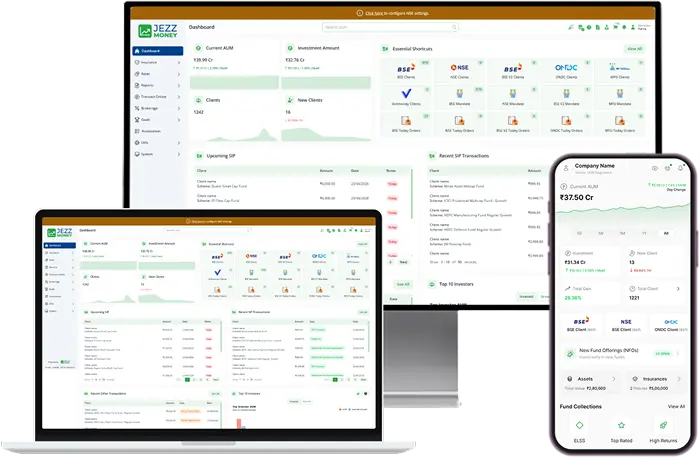
They save time, reduce manual errors, and make it easier to explain scenarios in a professional manner. JezzMoney is one of the fast-growing platforms in this space.

3. Monte Carlo Simulations

This is a more advanced approach used for deeper analysis. Instead of just three scenarios, Monte Carlo simulations generate hundreds or thousands of possible outcomes based on probability.

It helps in:

  • Estimating the probability of achieving financial goals
  • Understanding the range of possible portfolio outcomes
  • Evaluating risk under different market conditions

While highly effective, it may not be necessary for every advisor. For most MFDs and IFAs, simple scenario analysis (best, base, worst) is sufficient for clear and effective client communication.

Choosing the Right Approach

In practice, the choice of tools depends on the advisor’s scale and client requirements.

  • Start with Excel for flexibility and control
  • Adopt software tools to improve efficiency and presentation
  • Use advanced simulations for complex portfolios or high-value clients

Many advisors begin with basic tools and gradually transition to more sophisticated solutions as their advisory practice evolves.

Common Mistakes in Scenario Analysis

Scenario analysis is a powerful tool, but only when applied correctly. Many advisors and investors make avoidable mistakes that reduce its effectiveness and may lead to poor financial decisions.

  • Using unrealistic return assumptions: Assuming overly high or overly conservative returns can distort outcomes. Unrealistic inputs lead to misleading projections, creating either false confidence or unnecessary fear.
  • Ignoring the worst-case scenario: Focusing only on positive or average outcomes may keep clients comfortable, but it defeats the purpose. Scenario analysis must prepare for downside risks as much as upside potential.
  • Treating it like a prediction tool: Scenario analysis is not forecasting. Relying on one scenario as the expected outcome undermines its purpose. It should always be presented as a range of possibilities.
  • Not updating scenarios regularly: Market conditions, interest rates, and client goals evolve over time. Using outdated assumptions reduces the relevance and accuracy of the analysis.
  • Overcomplicating the model: Adding too many variables or complex calculations can create confusion. The objective is clarity and usability, not unnecessary complexity.
  • Ignoring inflation and real returns: Evaluating only nominal returns without accounting for inflation can misrepresent actual wealth creation and goal achievement.
  • Poor communication with clients: Even a well-structured analysis can fail if not explained clearly. Excessive jargon or lack of real-life context reduces client understanding and trust.
  • Not linking scenarios to decisions: Scenario analysis should drive action. If it does not influence asset allocation, investment strategy, or client behavior, it becomes purely theoretical.

Avoiding these mistakes ensures that scenario analysis remains a practical, reliable, and impactful tool for effective financial planning and client guidance.

Who Should Use Scenario Analysis?

Scenario analysis is useful for anyone involved in financial decision-making, but its value increases when applied consistently and systematically.

Retail Investors

Individual investors can use scenario analysis to understand how their investments may perform under different market conditions.

It helps them:

  • Set realistic return expectations
  • Avoid panic during market volatility
  • Make better long-term investment decisions

Mutual Fund Distributors (MFDs)

For MFDs, scenario analysis is a powerful tool for client engagement and advisory.

It helps in:

  • Explaining returns without overpromising
  • Clearly presenting both upside and downside scenarios
  • Improving client trust and retention
  • Differentiating from purely transactional distributors

IFAs (Independent Financial Advisors)

IFAs can use scenario analysis to deliver more structured and professional advice.

It enables them to:

  • Align investment strategies with client risk profiles
  • Provide goal-based planning with greater clarity
  • Handle client objections using data-backed scenarios
  • Strengthen their advisory positioning

Financial Planners

For financial planners, scenario analysis is a core component of comprehensive financial planning.

It is used to:

  • Test different financial strategies
  • Evaluate goal feasibility
  • Optimize asset allocation
  • Prepare clients for long-term uncertainties

In simple terms, anyone looking to move from guesswork to structured financial decision-making can benefit from scenario analysis—whether managing personal investments or advising clients professionally.

Summary

Scenario analysis is a practical method to make better financial decisions in uncertain market conditions. Instead of relying on a single prediction, it considers multiple possibilities, enabling investors and advisors to plan with greater clarity and confidence.

The core principle is simple: it’s not about predicting what will happen, but preparing for what can happen. This shift in approach leads to better risk management, more realistic goal setting, and stronger long-term outcomes.

For MFDs, IFAs, and financial planners, scenario analysis is more than just a tool. It enhances client communication, builds trust, and supports a more structured and professional advisory approach.

Scenario analysis improves decision-making in uncertain environments by helping investors and advisors evaluate multiple outcomes instead of relying on a single assumption. It supports better risk management by clearly outlining potential downside scenarios, while also aligning investment strategies with realistic expectations. Over time, this approach strengthens financial planning by making it more resilient and adaptable to changing market conditions.

If you want to make better investment decisions and guide clients with clarity, scenario analysis is no longer optional it is essential.

As advisory practices evolve, using advanced tools can further enhance efficiency and client experience. Platforms like JezzMoney help automate scenario analysis, streamline operations, and deliver more effective financial planning solutions.

Explore the platform: JezzMoney – AI Mutual Fund Distributor Software for smarter financial planning

FAQs about Scenario Analysis

What is scenario analysis in finance?

What is a simple example of scenario analysis?

Why is scenario analysis important for investors?

How do MFDs and IFAs use scenario analysis?

Is scenario analysis better than forecasting?

What are the types of scenario analysis?

Can scenario analysis predict exact returns?

Which tools are used for scenario analysis?