Home Blog How To Choose Mutual Funds

How to Choose Mutual Funds: Why Chasing Top Performers Can Be Risky

When choosing a mutual fund, investors often focus on recent returns, top rankings, popular funds, or recommendations from friends and social media. But a fund that performed well recently may not be the right choice for every investor.

Good mutual fund selection should consider your financial goals, investment horizon, risk profile, asset allocation, and overall portfolio. Understanding how to choose mutual funds based on these factors can help investors make more informed decisions.

This is where an experienced Mutual Fund Distributor (MFD) can provide valuable guidance and help investors stay focused on their long-term goals.

Why Investors Chase Top-Performing Mutual Funds

Investors often notice mutual funds that are delivering strong recent returns or getting a lot of attention. When many people choose the same fund, it can feel like the investment must be safe or reliable. But popularity does not always mean suitability.

Social Proof Makes Popular Funds Look Safer

When investors see friends, family, or other investors choosing a particular fund, they may feel more confident following the same choice. This social proof can make a popular fund seem less risky, even when its actual risk is higher.

Recency Bias Makes Recent Returns Look More Important

Investors naturally pay more attention to recent performance. A fund that has delivered strong returns over the past one or three years may seem more attractive, but short-term performance does not always reflect how the fund may perform across different market cycles.

Rankings Make Fund Selection Seem Easier

Fund rankings can help compare performance, but they are only one part of mutual fund selection. A top-ranked fund may still have a different risk level, investment strategy, or portfolio composition than what an investor needs.

Media and Social Platforms Amplify Popular Funds

Financial news, magazines, social media, fund rankings, and influencers’ opinions can drive the popularity of certain investment funds and push investors into specific investment areas. Investors are influenced by what they see in the markets and popular trends; however, it is also crucial to realize that what seems interesting and attractive is not necessarily suitable. Therefore, a mutual fund needs to be reviewed against the backdrop of an investor’s financial needs, goals, investment risk tolerance, and time horizon, and not just popularity and performance.

How Chasing Mutual Fund Performance Can Affect Investors

Focusing too much on recent mutual fund performance can lead investors to make decisions based on market trends rather than their long-term plans. The problem often starts when investors enter after strong returns and exit when performance becomes weak.

Buying After a Fund Has Already Rallied

A common pattern looks like this:

Strong performance → More attention → Growing popularity → Higher investor interest → Late entry

By the time a fund becomes widely popular, much of its recent growth may already have happened. Following past mutual fund performance without understanding the reasons behind it can increase the risk of entering at the wrong time.

Selling When Performance Falls

When markets decline, investors may worry about losing money and sell their investments in response to short-term losses. This emotional reaction can turn temporary market volatility into a permanent loss and move investors away from their long-term plans.

Moving From One Recent Winner to Another

Some investors repeatedly switch from one high-performing fund to another. This can make mutual fund investment decisions reactive and difficult to manage. Frequent switching may also prevent investors from following a consistent investment strategy.

Ignoring the Original Investment Goal

Every investment should have a purpose. A portfolio designed for retirement may need a different approach from one created for a short-term financial goal. Choosing or changing funds based only on recent performance can take investors away from what they originally planned to achieve.

The better approach is to review investments in the context of goals, risk, time horizon, and the overall portfolio, not just recent returns.

What Makes a Mutual Fund Suitable for an Investor?

Choosing the right mutual fund isn't just about finding the fund with the highest returns. A suitable investment should match your financial goals, risk profile, time horizon, and overall portfolio.

Start With Your Financial Goal

Begin by identifying what you are investing for. It could be:

  • Retirement
  • Child's education
  • Wealth creation
  • Home purchase
  • Long-term financial security

Your goal helps determine how much you need to invest and which investment approach fits.

Consider Your Investment Time Horizon

The time you have before you need the money can influence how much market risk you can take. A long-term goal may allow more time to manage market fluctuations, while a short-term goal may require a more conservative approach.

Understand Your Risk Profile

Every investor has a different ability and willingness to handle market volatility. Consider your:

  • Risk tolerance
  • Financial capacity to absorb losses
  • Comfort with market fluctuations

Understanding your risk profile can help you avoid choosing a fund that is hard to stay invested in during market declines.

Evaluate the Fund's Investment Strategy

Before investing, understand what the fund is designed to do. Look at its:

  • Investment objective
  • Investment style
  • Asset allocation
  • Portfolio construction
  • Sector and stock exposure

This helps you determine whether the fund fits your investment requirements.

Look Beyond One-Year Returns

Recent returns can be useful, but they should not be the only factor in mutual fund selection. Consider how the fund has performed across different market conditions and over multiple periods.

Check Portfolio Overlap

Investing in multiple mutual funds does not necessarily mean your portfolio is diversified, since different funds can hold the same stocks or sectors. Overlap in a portfolio can create unnecessary concentration.

Evaluate Fund as Part of Your Portfolio

Do not evaluate your mutual fund as an independent entity. Consider it in the context of the rest of your portfolio, risk, allocation, goals, and so on. Your ideal mutual fund is not the most popular or highest-performing one; it is the one that fits your investment plan and keeps you on track toward your financial goals.

Why Past Performance Alone Is Not Enough

Past performance can help you understand how a mutual fund has done in the past. But it shouldn't be the only factor you consider when deciding whether to invest. Past performance isn't an indicator of future performance, and markets can change.

Market Cycles Make Some Funds Outperform Others

Markets tend to follow cyclical patterns, and different sectors, styles, and asset classes tend to do better or worse than others during different market cycles.

Today's Top Performer May Not Remain Tomorrow's Top Performer

Mutual fund rankings can change as market conditions, valuations, sectors, and portfolio strategies change. A fund at the top of the performance chart today may not remain there in the future. This is why investors should look beyond rankings when making mutual fund investment decisions.

Risk-Adjusted Performance Matters

Returns are only one part of evaluating a mutual fund. Investors should also consider how much risk the fund took to achieve those returns. Some useful measures include:

  • Volatility: How much the fund's returns fluctuate.
  • Drawdown: How much the fund has fallen from a previous peak.
  • Sharpe ratio: Return relative to the risk taken.
  • Consistency: How the fund has performed across different market conditions.

These factors provide a broader view of a fund's performance rather than focusing only on its highest return.

Portfolio Fit Matters More Than Popularity

Instead of asking:

“Which fund gave the highest return?”

Investors should ask:

“Which investment fits my goals, risk profile, time horizon, and overall portfolio?”

A suitable mutual fund is not necessarily the one with the highest recent return. It is the one that fits the investor's needs and supports a well-planned investment strategy.

Common Mutual Fund Selection Mistakes Investors Should Avoid

Choosing a mutual fund based on popularity or recent performance can lead to decisions that may not match an investor's financial goals. Understanding common mutual fund selection mistakes can help investors make more informed decisions.

Choosing a Fund Only Because It Has the Highest Returns

A fund with the highest recent returns may look attractive, but returns alone do not show the level of risk involved. Investors should consider performance along with the fund's strategy, risk, consistency, and suitability.

Investing Because Everyone Else Is Investing

A popular mutual fund is not automatically the right investment for everyone. Following what friends, family, or other investors buy can lead to decisions that don't match your goals or risk profile.

Stopping SIPs During Market Corrections

Market corrections can make investors uncomfortable, but stopping a SIP because of short-term volatility can disrupt a long-term investment strategy. Review SIPs based on financial goals and circumstances, not market emotions alone.

Owning Too Many Similar Funds

Holding multiple mutual funds does not necessarily provide better diversification. Several funds may invest in similar stocks, sectors, or asset classes, creating unnecessary portfolio overlap.

Switching Funds Too Frequently

Switching funds too often based on recent performance can make investments reactive. Fund changes should have a clear reason and should be considered in the context of the overall portfolio.

Ignoring Risk and Time Horizon

A mutual fund should match an investor's ability to handle market fluctuations and the time available to reach the financial goal. Ignoring these factors can lead to unsuitable investment choices.

Making Decisions Based on Social Media Recommendations

Social media can provide useful information, but recommendations may not consider an investor's personal goals, risk profile, or existing portfolio. Investors should verify information and consider their own circumstances before making investment decisions.

Reviewing Individual Funds Without Reviewing the Overall Portfolio

A fund may perform well on its own but still not improve the overall portfolio. Regular portfolio reviews can help investors identify concentration, overlap, asset-allocation issues, and whether their investments remain aligned with their goals. The key is to make mutual fund decisions based on a structured investment plan, not popularity, short-term returns, or market noise.

How an MFD Helps Investors Make Better Mutual Fund Decisions

Choosing a mutual fund is only one part of successful investing. Investors also need guidance to understand their goals, manage risk, review their portfolios, and stay disciplined through changing market conditions. This is where a Mutual Fund Distributor (MFD) can add value.

Understanding Investor Goals

An MFD starts by understanding what the investor wants to achieve, whether it is retirement planning, children's education, wealth creation, or another financial goal. This helps create an investment approach based on the investor's needs, not market trends.

Matching Investments With Risk and Time Horizon

Different investors have different risk profiles and investment horizons. An MFD can help investors consider these factors when evaluating mutual funds and building a portfolio appropriate to their circumstances.

Conducting Mutual Fund Research

Instead of relying only on recent returns or rankings, an MFD can evaluate fund objectives, investment strategy, portfolio composition, performance consistency, and risk.

Reviewing Portfolio Diversification

An MFD can review the overall portfolio to identify concentration and overlap across funds. This helps investors understand whether their investments are genuinely diversified.

Monitoring Portfolio Performance

Regular portfolio reviews help investors understand how their investments are progressing toward their goals and whether changes are needed as their circumstances or market conditions change.

Helping Investors During Market Volatility

Market corrections can create fear and emotional decision-making. An MFD can provide context during volatile periods and help investors evaluate whether a change is actually necessary or simply a reaction to short-term market movements.

Maintaining Long-Term Investment Discipline

Good investing is not just about selecting a fund. It is also about staying consistent with a well-defined plan. An MFD can help investors remain focused on their goals instead of constantly reacting to market noise.

An MFD's role goes beyond helping investors buy a mutual fund. It provides context, discipline, portfolio support, and guidance throughout the investment journey.

How JezzMoney Supports Modern Mutual Fund Distributors

Modern MFDs need more than a system for recording transactions. They need technology that helps them manage clients, research mutual funds, review portfolios, handle investments, and provide better investor servicing.

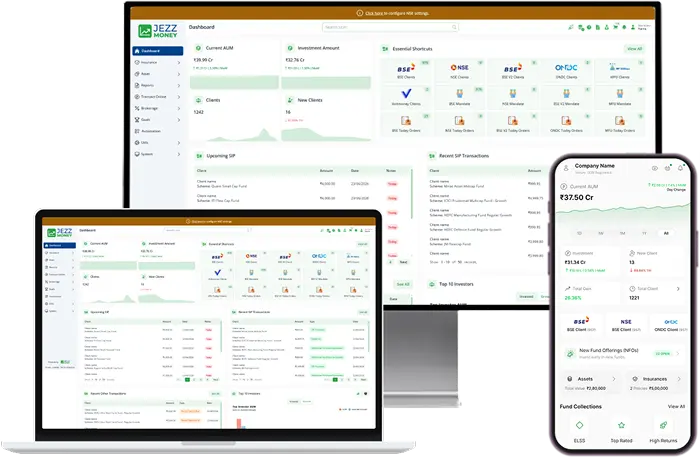
JezzMoney brings these activities together through a connected mutual fund distributor software platform, helping MFDs manage their day-to-day operations more efficiently while staying focused on investor relationships.

Centralized Client Management

JezzMoney helps MFDs organize investor information in one place and manage client relationships more efficiently. A centralized view of client details can make follow-ups, servicing, and ongoing investor communication easier to manage.

Mutual Fund Research and Analysis

Good investor guidance requires more than looking at recent returns. JezzMoney provides mutual fund research and analysis tools that can help MFDs access relevant fund information and have more informed conversations with investors.

Portfolio and AUM Management

Understanding an investor's existing portfolio is important when making investment decisions. JezzMoney gives MFDs visibility into investor portfolios and AUM, helping them conduct more structured portfolio reviews and identify areas that may need attention.

SIP and Investment Management

SIPs require ongoing management and investor servicing. JezzMoney supports SIP and investment workflows, helping MFDs manage recurring investments and stay connected with investors throughout their investment journey.

Digital Investor Onboarding

Digital onboarding can make the investor journey faster and more convenient. JezzMoney supports digital onboarding processes including:

  • KYC
  • FATCA
  • PAN validation
  • Digital investor onboarding

This helps reduce manual steps and creates a more streamlined experience for both MFDs and investors.

Financial Calculators

Financial calculators can help MFDs move investment conversations from products to financial goals. SIP, lump sum, retirement, and other calculators can help investors understand potential investment requirements and make goal-based planning discussions easier.

Transaction Connectivity

Mutual fund distribution does not depend on a single transaction ecosystem. JezzMoney supports connectivity across multiple transaction platforms, including BSE, NSE, BSE 2.0, MFU, and ONDC. This broader transaction infrastructure gives MFDs more flexibility in managing mutual fund transactions and supports a more connected distribution workflow.

A More Connected MFD Workflow

The real value of technology comes from connecting different activities instead of managing each one separately. JezzMoney brings key parts of the MFD workflow together:

Research → Planning → Client → Portfolio → Transaction → Review → Servicing

JezzMoney helps MFDs spend less time managing fragmented processes and more time providing meaningful investor guidance. The goal isn't simply to automate operations, but to create a more efficient, connected way for MFDs to manage their business and support investors.

Building a Better Mutual Fund Selection Process

Choosing a mutual fund becomes easier when investors follow a structured process instead of making decisions based on popularity, recent returns, or market noise. A simple process helps investors connect each investment decision to their financial goals.

Step 1: Define the Financial Goal

Start by identifying what you are investing for, such as retirement, education, wealth creation, or another financial goal. A clear goal gives your investment strategy direction.

Step 2: Determine the Investment Horizon

Understand how long you can stay invested before you need the money. Your investment horizon can influence how much market risk you can handle.

Step 3: Understand Risk Tolerance

Consider how comfortable you are with market fluctuations and potential losses. Choosing investments that match your risk profile can make it easier to stay invested during volatile periods.

Step 4: Research Suitable Fund Categories

Identify mutual fund categories that may be appropriate for your goal, time horizon, and risk profile. Do not start with a specific fund simply because it is currently popular or highly ranked.

Step 5: Evaluate Fund Strategy and Portfolio

Understand how the fund invests, what its objective is, and what types of stocks, sectors, or assets it holds. This helps determine whether the fund fits your investment plan.

Step 6: Compare Risk and Consistency

Look beyond returns and evaluate volatility, drawdowns, and performance consistency across different market conditions. A broader evaluation provides better context for selecting mutual funds.

Step 7: Check Portfolio Overlap

If you already own mutual funds, check whether the new fund has significant overlap with your existing investments. This can help avoid unnecessary concentration and improve portfolio diversification.

Step 8: Invest According to the Plan

Once you have evaluated the investment, make decisions based on your financial plan rather than short-term market trends or outside pressure.

Step 9: Review Periodically

Review investments periodically to ensure they remain aligned with your goals, risk profile, asset allocation, and changing financial circumstances.

Step 10: Avoid Reacting to Short-Term Market Noise

Market movements, headlines, rankings, and social media discussions can influence investor decisions. Avoid making frequent changes based only on short-term events. Focus on the original investment objective and long-term plan.

The goal is not to find the most popular or highest-performing mutual fund. The goal is to follow a process that helps you choose investments that fit your needs and stay aligned with your financial goals.

Why Investors Need Context, Not Just More Information

Investors today have access to more mutual fund information than ever before. They can quickly find fund rankings, returns, ratings, YouTube videos, social media discussions, market news, fund comparison platforms, and even AI-generated information.

Having access to information is useful, but more information does not always lead to better investment decisions. In fact, too many opinions, rankings, and market updates can sometimes create confusion and encourage investors to keep changing their decisions.

Information Tells Investors What Happened

Investors can easily find out which fund delivered the highest return, which sector is performing well, or which funds are currently popular. These facts can provide useful starting points, but they don't explain whether an investment suits a particular investor.

Context Helps Investors Understand What It Means

The more important question is what that information means for the investor's own portfolio. A fund may have delivered strong returns, but does it match the investor's risk profile? Does it fit the investment horizon? Is there already similar exposure in the portfolio? Does changing the investment support the original financial goal?

Information tells investors what happened. Context helps them understand what it means for their portfolio.

Where an MFD Can Add Value

An MFD can help connect investment information with an investor's actual financial situation. Instead of simply showing rankings or performance figures, an MFD can provide context around goals, risk, portfolio allocation, fund suitability, and long-term investment plans. This becomes especially important during volatile markets, when investors may have access to hundreds of opinions but still need help deciding what action, if any, is appropriate.

The value of an MFD is therefore not just providing more information. It is helping investors understand the right information, put it into context, and make decisions based on a structured investment plan.

Summary

Choosing a mutual fund should not be about following the crowd or chasing the latest top performer. A fund that is popular today or has delivered strong recent returns may not necessarily be the right choice for every investor.

A better approach is to choose investments based on financial goals, risk profile, investment horizon, and overall portfolio fit. A structured process can help investors make more informed decisions and stay focused amid changing market conditions. For MFDs, delivering this kind of structured investor experience requires more than mutual fund knowledge. It also requires the right technology to manage client information, research, portfolios, SIPs, transactions, onboarding, and ongoing investor servicing.

JezzMoney's mutual fund distributor software brings these activities together through a connected platform, helping MFDs run operations more efficiently and give investors a more organized, informed investment experience.

The goal is simple: help investors choose with context, help MFDs work with clarity, and build a more disciplined approach to mutual fund investing.

FAQs about How to Choose Mutual Funds

What should I consider before choosing a mutual fund?

Is it safe to invest in top-performing mutual funds?

Why should investors not rely only on past mutual fund returns?

How do I choose the right mutual fund for my goals?

How does an MFD help investors choose mutual funds?

What is mutual fund distributor software?

How can JezzMoney help mutual fund distributors manage their business?