

Home Blog Mfd Recurring Revenue Model

How to Build a Recurring Revenue Model as a Mutual Fund Distributor

If you are thinking about becoming a mutual fund distributor, it is very natural for one of the first questions to pop into your mind to be, how much do mutual fund distributors make?" Several people just Google things like a mutual fund distributor's salary, mutual fund distributor income, or how a mutual fund distributor gets paid, looking for a regular monthly paycheck just like the one you get from your office job. But this is totally wrong, and the truth is far removed from those expectations.

A mutual fund distributor can never expect to get a fixed salary from the Asset Management Companies (AMCs). Rather than being dependent on someone, being a mutual fund distributor is a business activity. And your income will only increase if you can create and sustain client investments. Factors including trail commissions, client retention, Assets under management (AUM), SIP growth, and overall business growth will determine how much you will earn from MFD Business.

What makes this occupation so appealing is the repeating revenue model that the industry follows. Most businesses keep coming up with new customers all the time, while mutual fund distributors can build sustainable income through long-running relationships with investors. Whenever investors keep their Systematic Investment Program (SIP) and do not leave the mutual funds, fund houses will continue paying fund distributors trail commissions, and this way distributors keep earning stable, expandable revenue over time.

For this reason, senior Mutual Fund Distributors (MFDs) will not spend their time just getting a one-time commission; instead, their primary focus will shift towards increasing AUMs, increasing the number of SIPs, and retaining investors for a longer duration. Mutual Fund distribution is one of those rare avenues where, as your investment book grows, your recurring earnings also grow.
Is There a Fixed Salary for a Mutual Fund Distributor?

Unlike employees working for banks, financial institutions, or Asset Management Companies (AMCs), Mutual Fund Distributors (MFDs) are independent business owners and entrepreneurs. They are not on the payroll of any AMC, which means there is no guaranteed monthly salary or annual increment. Instead, they earn money based on business outcomes. Various metrics, such as Assets Under Management (AUM), the number of active investors, client retention rate, SIP registrations, and long-term portfolio growth, determine how much a mutual fund agent earns.

This kind of business operation not only opens doors for very high earnings but also provides flexibility as there are no restrictions on how much you can earn. As distributors bring in more clients, keep investors with them in the long run, and increase their AUM, the distributor's trail commission income, which is settled periodically, may increase substantially over the years. Basically, a regular-salary job is a kind of trade where you spend your time for a fixed amount of pay; on the other hand, a mutual fund distributor is a kind of business that is easy to scale up, and as your clients' value increases, your income also increases.

Employee vs. Independent Mutual Fund Distributor

Employee Independent Mutual Fund Distributor
Receives a fixed monthly salary No fixed salary
Limited incentives and bonuses Unlimited earning potential
Monthly income remains relatively fixed Income is primarily commission-based
Employer decides salary increments Income grows as AUM and client base increase
Job security depends on employer Business growth depends on performance and client relationships
Limited control over earnings Greater control over income through business expansion

For individuals who are willing to build long-term client relationships and consistently grow their investment book, mutual fund distribution offers the opportunity to create a sustainable, recurring-income business rather than relying on a fixed monthly salary.

How Much Does a Mutual Fund Distributor Earn in India?

There is no single answer to how much a mutual fund distributor earns in India because income varies significantly from one distributor to another. Unlike salaried professionals, mutual fund distributors earn based on the size and quality of the business they build over time.

Several factors influence a distributor's earning potential, including:

  • Experience: Experienced distributors typically have stronger client relationships and larger investment books.
  • Number of Active Clients: More active investors generally translate into higher Assets Under Management (AUM).
  • Assets Under Management (AUM): A larger AUM can generate higher recurring trail commission income.
  • Client Retention: Investors who stay invested for the long term continue contributing to recurring revenue.
  • Investment Discipline: Regular SIP investments and long-term wealth creation help distributors steadily grow their AUM and income.

Rather than focusing only on acquiring new investors, successful distributors prioritize increasing their SIP book, retaining existing clients, and expanding family portfolios. This creates a sustainable business with predictable recurring income.

Illustrative Income Potential Based on AUM

The following examples are for illustration purposes only and are intended to demonstrate how recurring income generally grows as Assets Under Management (AUM) increase.

Assets Under Management (AUM) Estimated Annual Income Potential*
₹50 Lakhs Lower trail income
₹5 Crore Moderate recurring income
₹25 Crore Significant recurring income
₹100+ Crore High recurring revenue

When the client base grows, and investing continues through SIPs and long-term holdings, the distributor can benefit from a steady income flow that keeps increasing with each passing year. 

How Mutual Fund Distributors Earn Money

The question that is almost always raised among people is, "How do mutual fund distributors actually make money?" Unlike a regular salary earner, mutual fund distributors primarily earn their living from commissions earned through clients' mutual fund investments and by developing long-lasting relationships with clients. Their income will grow proportionately with the rise in their Assets Under Management (AUM), retention of investors, and promoting regular SIP investments.Th.

Below are the major ways through which a mutual fund distributor can earn:

1. Trail Commission (Main Source)

Trail commission is the main and most reliable way of earning for mutual fund distributors. This type of commission is periodically paid on the assets invested by clients, so that if the client stays with the mutual fund scheme, he will continue to pay the distributor commission as well. Of course, this depends on the regulations and AMC commission structures.

How Trail Commission Works

  • Earned on the value of invested assets under management (AUM).
  • Paid periodically while the investment remains active.
  • Increases as AUM grows through new investments, SIPs, and market appreciation.
  • Encourages long-term client relationships instead of short-term transactions.

Benefits of Trail Commission

  • Creates a predictable recurring income stream.
  • Revenue grows as the investment portfolio expands.
  • Supports business scalability without relying solely on new client acquisition.
  • Encourages long-term wealth creation for both investors and distributors.

2. Pre-Sale Commission (If the Regulations and the Rules Allow)

Occasionally, given SEBI rules and AMC policies, mutual fund distributors may be offered an upfront commission at the time of investment only for certain types of investments. It is a one-off commission paid at the time of investment, so it does not continue throughout the investment period.

Upfront commissions are a quick way to get a cash influx but are not viewed positively over time, especially when compared to trail commissions. The reason is that trail commissions bring the distributors the commission periodically over the investment period, and therefore the trail is a continuous source of income for the distributors. That's why good distributors prioritize building trail revenue, which is achieved by forging strong, lasting relationships with their clients as well as increasing their assets under management (AUM).

3. Additional Business Opportunities

Apart from commission-related income, several mutual fund distributors go beyond and also deliver added-value financial services to clients in a way that the client's bond with the distributor is not only retained but actually becomes stronger, and the Assets Under Management (AUM) goes up too. These services also improve client retention rates and generate more referral opportunities.

Some common business opportunities include:

  • Financial Planning: Helping clients create personalized investment strategies based on their financial objectives.
  • Goal-Based Planning: Designing investment plans for retirement, children's education, home purchase, wealth creation, and other life goals.
  • SIP Advisory: Guiding investors in selecting suitable SIP amounts, investment duration, and fund categories based on their risk profile.
  • Portfolio Reviews: Conducting regular portfolio health checks and recommending adjustments when required.
  • Family Account Management: Managing investments for spouses, children, parents, and extended family members to increase household AUM.
  • Referral Network: Growing the business through referrals from satisfied clients and professional partners such as Chartered Accountants, insurance advisors, and tax consultants.

Build Long-Term Income, Not Just Short-Term Commissions

The most successful mutual fund distributors understand that sustainable earnings come from building long-term assets rather than chasing one-time commissions. By focusing on client retention, consistent SIP investments, regular portfolio reviews, and increasing Assets Under Management (AUM), distributors can create a recurring revenue model that continues to grow year after year.

Why Trail Commission Creates True Recurring Revenue

Trail commission is what makes mutual fund distribution a recurring revenue business rather than a profession that depends on one-time earnings. Instead of receiving payment only when a client invests, mutual fund distributors continue earning trail commissions on eligible investments as long as investors remain invested, subject to applicable regulations and AMC commission structures.

This creates a sustainable income model where today's efforts can continue generating revenue for years to come.

Every SIP Adds Future Income

Every new Systematic Investment Plan (SIP) contributes to your future Assets Under Management (AUM). As investors make regular monthly investments, their portfolio value grows over time, increasing the base on which trail commissions are earned.

Rather than relying on a constant stream of new clients, each SIP strengthens your recurring income and builds a more stable business.

Existing Clients Continue Generating Revenue

Acquiring new investors is important, but retaining existing clients is even more valuable. Investors who stay invested for the long term continue contributing to your AUM, allowing your trail income to grow without starting from scratch every month.

This is why successful mutual fund distributors focus on regular portfolio reviews, goal-based planning, timely communication, and excellent client service to improve long-term retention.

Compounding Benefits Both Investors and Distributors

Compounding is one of the most powerful concepts in investing, and it benefits both parties. For investors, regular SIP investments can build wealth over the long term through the power of compounding. For distributors, as client investments and AUM grow over time, recurring trail commissions can also increase, creating a scalable and predictable income stream. The longer investors remain invested and continue their SIPs, the stronger the distributor's recurring revenue model becomes.

How Recurring Income Grows

Year 1

100 Active Clients

        │

        ▼

Monthly SIP Investments

        │

        ▼

Growing Assets Under Management (AUM)

        │

        ▼

Increasing Trail Commission

        │

        ▼

Stable & Recurring Monthly Income

This illustration demonstrates why experienced mutual fund distributors prioritize building long-term relationships instead of chasing one-time commissions. Every satisfied client, every new SIP, and every increase in AUM contributes to a stronger recurring revenue stream, helping create a business that becomes more stable and scalable with time.

How to Build a Recurring Revenue Model as a Mutual Fund Distributor

Building a successful mutual fund distribution business isn't about earning the highest commission from a single transaction; it's about creating a recurring revenue model that generates consistent income year after year. The most successful Mutual Fund Distributors (MFDs) focus on increasing their Assets Under Management (AUM), retaining clients, encouraging regular SIP investments, and leveraging technology to scale efficiently.

Here are the key strategies for building a sustainable, scalable recurring-income business.

1. Focus on SIP Investors

Systematic Investment Plans (SIPs) are the foundation of recurring revenue for mutual fund distributors. Every new SIP contributes to a growing investment book, which can generate trail commission over the long term (subject to applicable regulations and AMC commission structures).

Why SIP Investors Matter

  • Consistent monthly investments increase AUM over time.
  • Investors are more likely to stay invested for the long term.
  • Predictable cash flow makes future business growth easier to plan.
  • Regular SIPs help create a stable and recurring trail income.

Rather than concentrating only on large lump sum investments, building a strong SIP book creates a more resilient and sustainable business.

2. Increase Client Retention

Acquiring new clients is important, but retaining existing investors is even more valuable. Long-term clients continue contributing to your AUM, resulting in recurring income and stronger referral opportunities.

Improve client retention by:

  • Conducting regular portfolio review meetings.
  • Tracking financial goals and investment progress.
  • Sharing timely market updates and investment insights.
  • Maintaining consistent communication through WhatsApp, email, and phone calls.
  • Providing prompt support whenever clients need assistance.

Satisfied clients not only stay invested but also recommend your services to others.

3. Grow Your Assets Under Management (AUM)

AUM is one of the biggest drivers of a mutual fund distributor's income. The larger your investment book, the greater your recurring earning potential.

Some effective strategies include:

  • Upselling additional investments to existing clients.
  • Managing investments for the entire family instead of a single investor.
  • Conducting investor awareness sessions for corporate employees.
  • Serving Non-Resident Indians (NRIs) looking to invest in Indian mutual funds.
  • Encouraging clients to increase their SIP amounts whenever their income grows.

Small increases across hundreds of clients can significantly improve your overall AUM.

4. Diversify Across Mutual Fund Categories

Offering a diversified investment approach helps clients build balanced portfolios while expanding your business opportunities.

Consider recommending suitable investments across categories such as:

  • Equity Mutual Funds
  • Debt Mutual Funds
  • Hybrid Funds
  • ELSS (Tax Saving Funds)
  • Index Funds

A diversified portfolio improves client satisfaction and encourages long-term investment discipline.

5. Offer Goal-Based Financial Planning

Instead of selling mutual funds as standalone products, position yourself as a trusted financial advisor by helping clients achieve specific life goals.

Common financial goals include:

  • Retirement planning
  • Child education planning
  • Wealth creation
  • Tax planning
  • Home purchase planning
  • Emergency fund creation

Goal-based investing encourages investors to remain committed to their investment plans, improving both client outcomes and long-term retention.

6. Build a Strong Referral Network

Referral-based growth is one of the most cost-effective ways to acquire high-quality investors.

Expand your network through:

  • Existing satisfied investors
  • Chartered Accountants (CAs)
  • Insurance advisors
  • Real estate consultants
  • Tax consultants
  • Business owners and professional associations

Strong referral partnerships reduce client acquisition costs while improving trust and conversion rates.

7. Use Technology to Scale Your Business

As your client base grows, managing portfolios manually becomes increasingly challenging. Modern mutual fund distributor software helps automate routine tasks, improve client service, and provide valuable business insights. Solutions like JezzMoney enable distributors to streamline operations and focus on business growth instead of administrative work.

With JezzMoney, you can:

  • Simplify digital client onboarding.
  • Track individual and consolidated portfolios.
  • Manage family portfolios from a single platform.
  • Generate professional reports instantly.
  • Communicate with clients through integrated WhatsApp and email.
  • Access your business anytime using the mobile app.
  • Leverage built-in mutual fund research tools.
  • Use financial calculators for investment planning.
  • Monitor business performance with detailed analytics and dashboards.

By combining technology with strong client relationships, distributors can serve more investors efficiently, improve client satisfaction, and build a scalable recurring-income business.

Build a Business That Grows Every Year

To enjoy continued success as a mutual fund distributor, the focus must be on building relationships rather than one-time transactions. As the SIP book keeps growing, client retention improves, AUM increases steadily, and more diversified investment solutions are offered; combined with choosing the proper tech platform, you get regular and reliable income. In the long run, this strategy will change the fund distribution industry entirely, moving it from a commission-based profession to a scalable business model capable of generating substantial income over time.

Example of Recurring Income Growth

One of the biggest advantages of becoming a mutual fund distributor is that your income can grow alongside your business. As you gain more clients and increase SIP registrations, keep your clients satisfied. This will help grow your Assets Under Management (AUM) and can lead to a rise in your recurring trail commission income over time.

This example shows how a distributor can grow by gaining new clients and increasing SIP. These figures are for illustration only; they do not show real earnings or guaranteed results.

Illustrative Growth of a Mutual Fund Distribution Business

Year Active Clients Monthly SIP Book Estimated AUM Growth Recurring Income Trend
Year 1 50 ₹2 Lakhs Growing Low
Year 2 120 ₹6 Lakhs Strong Moderate
Year 3 250 ₹15 Lakhs High High
Year 5 500 ₹40 Lakhs Very High Stable & Scalable

What This Example Demonstrates

  • Year 1: The distributor begins building a client base and establishing a consistent SIP book. Recurring income starts to develop through trail commissions.
  • Year 2: More clients and higher monthly SIP registrations contribute to stronger AUM growth, resulting in a noticeable increase in recurring income.
  • Year 3: With a larger investment book and improved client retention, trail commission income becomes a significant and more predictable revenue source.
  • Year 5: A mature business with hundreds of active investors, a substantial SIP book, and strong AUM can generate a stable and scalable recurring income stream.

Common Mistakes That Limit Mutual Fund Distributor Income

Many mutual fund distributors concentrate on gaining new investors. However, they often neglect activities that ensure long-term, steady revenue. Onboarding new clients is important. True growth comes from increasing Assets Under Management (AUM), keeping investors, and providing steady value over time.

Avoiding the following common mistakes can help you build a stronger, more profitable mutual fund distribution business.

1. Chasing Only New Investors

Constantly pursuing new clients while neglecting existing ones can slow business growth. Existing investors are often the easiest source of additional investments, higher SIP amounts, and referrals.

Best Practice: Balance new client acquisition with nurturing your current investor base.

2. Ignoring Existing Clients

Clients who don't receive regular attention are more likely to stop SIPs, redeem investments, or move to another advisor.

Best Practice: Stay connected through regular reviews, market updates, and proactive support to build long-term trust.

3. Lack of Regular Follow-Up

Many investment opportunities are lost simply because distributors fail to follow up. Investors often need reminders, clarification, and confidence before making financial decisions.

Best Practice: Establish a structured follow-up process using calls, emails, WhatsApp messages, and scheduled review meetings.

4. Poor Documentation

Managing client records manually or maintaining incomplete documentation can lead to delays, compliance issues, and a poor client experience.

Best Practice: Keep client information, investment records, KYC details, and communication history organized in a secure digital system.

5. No Digital Presence

Investors expect to find financial professionals online. Without a professional website, social media presence, or educational content, attracting new clients becomes more difficult.

Best Practice: Build your online presence through a website, LinkedIn, social media, blogs, webinars, and investor education content.

6. Not Using a CRM or Business Management Software

Managing hundreds of clients through spreadsheets or manual records becomes inefficient as your business grows. Missed reminders, delayed communication, and disorganized data can impact both client satisfaction and business performance.

Best Practice: Use dedicated mutual fund distributor software or a CRM to automate client management, follow-ups, reporting, and business tracking.

7. Skipping Portfolio Reviews

Financial goals, market conditions, and investor requirements change over time. Without regular portfolio reviews, clients may lose confidence or miss opportunities to enhance their investments.

Best Practice: Schedule regular portfolio review meetings to assess performance, rebalance investments when appropriate, and align portfolios with clients' evolving goals.

8. Not Focusing on SIP Growth

Relying primarily on lump sum investments can result in inconsistent income. A strong SIP book helps create predictable AUM growth and recurring trail commission over the long term.

Best Practice: Encourage investors to start SIPs early, increase SIP amounts as income grows, and remain invested for the long term.

Successful mutual fund distributors don't grow their income by simply adding more clients; they grow by retaining investors, increasing SIP registrations, expanding AUM, and using technology to manage relationships efficiently. By avoiding these common mistakes, you can build a scalable business with a stronger recurring revenue model and long-term earning potential.

Best Practices for Increasing Mutual Fund Distributor Income

Growing your income as a mutual fund distributor isn't about finding shortcuts it's about consistently following proven business practices. Successful Mutual Fund Distributors (MFDs) focus on building long-term relationships, increasing Assets Under Management (AUM), and creating a sustainable recurring revenue model through disciplined processes.

Use the following checklist to strengthen your business and maximize your long-term earning potential.

Mutual Fund Distributor Success Checklist

Best Practice Why It Matters
Increase SIP Registrations Regular SIPs help build a steady investment book, increase AUM over time, and create recurring trail commission income.
Improve Client Retention Long-term investors continue contributing to recurring revenue and are more likely to refer new clients.
Conduct Regular Portfolio Reviews Periodic reviews keep portfolios aligned with clients' financial goals and strengthen trust and engagement.
Cross-Sell Within Families Expand your AUM by managing investments for spouses, children, parents, and other family members.
Build Trust Through Education Share market insights, investment updates, and financial guidance to establish yourself as a trusted advisor rather than just a distributor.
Stay Compliant Follow SEBI regulations, maintain proper documentation, and adhere to ethical business practices to build long-term credibility.
Use Automation and Technology Automate client onboarding, reminders, reporting, and communication to improve efficiency and serve more clients effectively.
Track Assets Under Management (AUM) Regularly monitor AUM growth to identify opportunities to increase investments and improve business performance.
Monitor Business KPIs Track key metrics such as active clients, SIP registrations, client retention, portfolio growth, revenue trends, and referral conversions to make informed business decisions.

Focus on Long-Term Business Growth

The top mutual fund distributors run their practice like a business, not just a sales job. They steadily grow their SIP book. They build long-term client relationships and use technology. They also track key performance indicators to improve all parts of their operations.

How JezzMoney Helps Mutual Fund Distributors Build Recurring Revenue

To build a successful mutual fund distribution business, you need more than just new clients. You also need effective client management, regular engagement, and data-driven choices. Plus, you must scale operations while keeping manual work to a minimum. That's where JezzMoney helps.

JezzMoney is an all-in-one platform for Mutual Fund Distributors (MFDs). It simplifies daily tasks, strengthens client ties, and helps build a steady revenue model. JezzMoney helps distributors by automating routine tasks. This way, they can spend less time on admin and focus more on growing their Assets Under Management (AUM).

Client & Family Management

Managing individual investors is only the beginning. JezzMoney allows you to organize and manage entire family portfolios from a single dashboard, making it easier to identify cross-selling opportunities, increase household AUM, and deliver a better client experience.

Portfolio Analysis

Gain deeper insights into client investments with advanced portfolio analysis tools. Track portfolio allocation, performance, asset distribution, and investment trends. This helps us give smart recommendations and keeps clients on track with their financial goals.

Consolidated Reports

Generate professional, consolidated portfolio reports in just a few clicks. You can quickly share detailed investment summaries instead of making reports by hand. This boosts transparency and builds client confidence.

Mutual Fund Research

Use built-in mutual fund research to assess schemes. Compare fund performance, analyze risk metrics, and make smart investment choices. Improved research leads to smarter investment choices. It also boosts your reputation as a reliable advisor.

Goal-Based Financial Planning

Help investors stay committed to long-term investing by creating financial plans based on their life goals, including:

  • Retirement planning
  • Child education planning
  • Wealth creation
  • Tax planning
  • Home purchase planning

Goal-based investing encourages higher client retention and consistent SIP investments, both of which contribute to recurring revenue.

WhatsApp & Email Integration

Maintain regular communication with clients through integrated WhatsApp and email features. Share portfolio updates, investment reports, reminders, and important notifications effortlessly to help you build stronger relationships and improve engagement.

Financial Calculators

JezzMoney offers a full set of financial calculators that make investment planning and client talks easier. These tools help investors make smart financial choices. They provide clear insights on SIP returns, retirement planning, and tax-saving options.

Mobile App Access

Stay connected to your business anytime, anywhere. JezzMoney's mobile app lets you access client info, portfolios, reports, and key business data. This way, you can respond quickly and manage your practice, even on the go.

Secure Data Management

Protecting investor information is critical. JezzMoney offers secure data management. This helps protect sensitive client information. With us, you can trust your daily operations to be reliable and private.

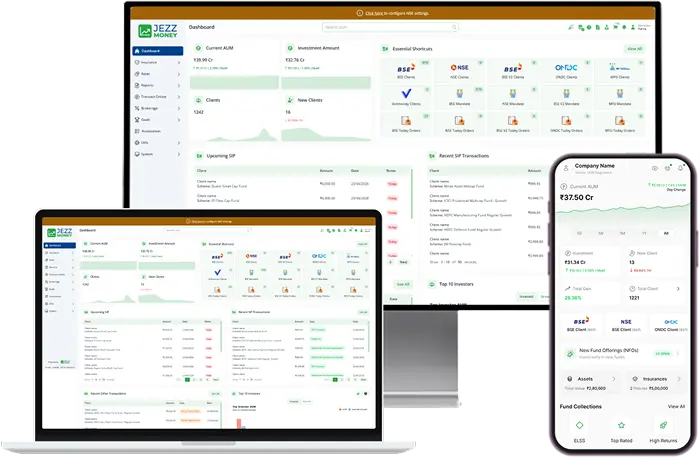
Business Performance Dashboard

Measure the health of your business with a powerful performance dashboard. Track key metrics such as:

  • Assets Under Management (AUM)
  • Active clients
  • SIP registrations
  • Portfolio growth
  • Client acquisition
  • Business trends and performance

With real-time insights, you can identify growth opportunities, monitor progress, and make data-driven business decisions.

Your Growth Partner for Building Recurring Revenue

JezzMoney is more than mutual fund distributor software. It's your partner in growth, helping you build a scalable, recurring-income business. Every feature, from client onboarding to portfolio management, boosts efficiency. It also strengthens client relationships and speeds up AUM growth. This includes communication, reporting, business analytics, and financial planning.

Summary

Mutual fund distribution doesn't follow a regular working pattern like a salary job. On the contrary, the mutual fund business is scalable and can provide you earning without a cap. Although the job comes with no assured monthly income, if you consistently raise your Assets Under Management (AUM), retain your clients, promote SIPs, and build long-lasting relationships, the result will be dependable recurring income over time.

The right technology can play a crucial role in accelerating your growth. JezzMoney assists mutual fund distributors by enabling them to manage their clients' database efficiently, complete their work-related tasks and activities through the automated system, and maintain complete control over their business data and progress through performance metrics. Moreover, it is a one-stop solution that frees up their time and energy to focus on growing AUM. Don't hesitate, and try out JezzMoney right now!

FAQs about Recurring Revenue Model

Does a mutual fund distributor get a fixed salary?

How much does a mutual fund distributor earn in India?

How do mutual fund distributors earn money?

What is trail commission in mutual funds?

Is mutual fund distribution a good business?

Can mutual fund distributors earn passive income?