Home Blog Types Of Etf In India

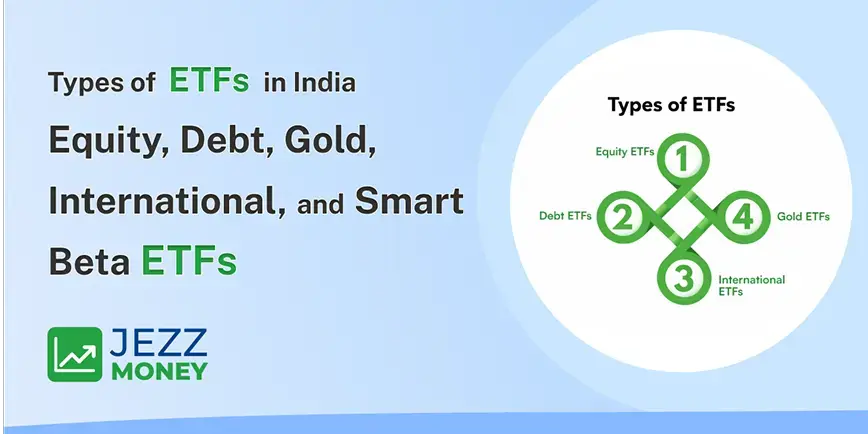
Types of ETFs in India: Equity, Debt, Gold, International, and Smart Beta ETFs

An ETF (exchange-traded fund) is a financial instrument that combines features of both mutual funds and stocks. It is a fund that tracks an underlying index, asset, or basket of securities and is traded on stock exchanges like regular shares. ETFs are designed to replicate the performance of their benchmark by holding the same securities in similar proportions, making market participation simpler and more efficient for investors.

The growth of exchange-traded funds in India has accelerated significantly over the past decade. This expansion has been driven by increased investor awareness, supportive regulatory developments, and a growing preference for passive investment strategies. Today, the Indian ETF market offers a wide range of choices across asset classes such as equities, debt instruments, gold, international markets, and factor-based strategies. Lower expense ratios, better liquidity, and easy access through online trading platforms have further encouraged adoption among both retail and institutional investors.

ETFs are particularly suitable for long-term investors as they promote disciplined, passive investing while reducing fund management risk and overall costs. Their transparent structure, potential tax efficiency in certain categories, and alignment with long-term financial objectives make ETFs a practical and sustainable option for building diversified investment portfolios over time.

What Are ETFs and How Do They Work in India?

Exchange-Traded Funds (ETFs) are market-linked investment funds that track the performance of a specific index, commodity, sector, or asset class. An ETF holds a basket of securities that mirrors its underlying benchmark and aims to deliver returns closely aligned with that index, subject to tracking error and expenses. Unlike traditional mutual funds, ETFs are listed and traded on stock exchanges, allowing investors to buy and sell them throughout market hours.

In India, ETFs are traded on recognised stock exchanges such as the National Stock Exchange of India and the Bombay Stock Exchange. Investors can transact in ETFs through a demat and trading account, similar to equity shares. ETF prices fluctuate in real time based on market demand, supply, and movements in the underlying assets. Market makers play an important role in maintaining liquidity and ensuring that ETF prices stay close to their net asset value (NAV).

The primary difference between ETFs and mutual funds lies in their structure, trading mechanism, and management style. ETFs are traded on stock exchanges at market prices, while mutual funds are bought and redeemed directly with the fund house at end-of-day NAVs. ETFs generally follow a passive investment approach by tracking an index and usually have lower expense ratios. In contrast, mutual funds especially actively managed ones rely on fund manager decisions, involve higher costs, and may deliver returns that vary from their benchmarks. A detailed comparison can be found here: difference between ETF and mutual fund.

ETFs are a core component of passive investing, a strategy that aims to match market returns rather than outperform them. Since ETFs track broad markets or specific segments, they eliminate the need for active stock selection and reduce stock-selection risk. Their typically lower expense ratios also make them cost-efficient. Through ETFs, Indian investors can gain diversified market exposure, benefit from long-term market growth, and build portfolios aligned with disciplined, long-term financial goals.

Major Types of ETFs in India

Exchange-Traded Funds (ETFs) in India can be broadly classified based on the asset class they track or the investment strategy they follow. Each ETF category has distinct risk–return characteristics and serves different investment objectives. Understanding these categories helps investors allocate capital effectively and build diversified portfolios aligned with both short-term needs and long-term goals.

Equity ETFs in India

Equity ETFs invest in shares of listed companies and aim to replicate the performance of a specific stock market index. These ETFs hold the same stocks in the same proportions as their benchmark index, ensuring transparency and close tracking of index returns. In India, most equity ETFs track broad-market indices such as the NSE Nifty and the BSE Sensex. There are also sectoral and thematic ETFs that focus on specific industries like banking, IT, pharmaceuticals, or consumer sectors.

Equity ETFs are sensitive to market volatility and can experience short-term price fluctuations. However, over long investment horizons, equities have historically delivered higher returns than most other asset classes. As a result, equity ETFs are suitable for investors with a long-term outlook and the ability to tolerate interim market swings.

Aspect Details
Asset Class Equity shares
Benchmark Type Broad-market, sectoral, or thematic indices
Risk Level Moderate to high
Return Potential High over the long term
Investment Horizon Long term
Suitable For Wealth creation and passive equity exposure

Debt ETFs in India

Debt ETFs invest in fixed-income instruments such as government securities, treasury bills, and corporate bonds. These ETFs aim to provide relatively stable returns with lower volatility compared to equity ETFs, making them suitable for conservative investors or those seeking income and portfolio stability.

Government bond ETFs carry minimal credit risk as they are backed by sovereign guarantees, while corporate bond ETFs may offer higher yields but involve moderate credit risk depending on the issuer. Debt ETFs are also sensitive to interest rate movements, particularly those with longer durations.

Aspect Details
Asset Class Fixed-income securities
Credit Risk Low (government bonds) to moderate (corporate bonds)
Interest Rate Sensitivity Moderate to high
Return Nature Stable and predictable
Investment Horizon Short to medium term
Suitable For Income generation and portfolio stability

Gold ETFs in India

Gold ETFs invest in physical gold of high purity and track domestic gold prices. Each unit represents a specific quantity of gold, allowing investors to gain exposure to gold price movements without the challenges of physical storage, security, or purity verification.

Compared to physical gold and digital gold, gold ETFs offer better liquidity, transparent pricing, and stronger regulatory oversight. They are commonly used as a hedge against inflation and market volatility due to their low correlation with equities.

Aspect Details
Asset Class Physical gold
Price Tracking Domestic gold prices
Storage Requirement None
Liquidity High
Risk Level Moderate
Suitable For Inflation protection and diversification

International ETFs in India

International ETFs give Indian investors exposure to overseas markets by tracking foreign indices. These ETFs allow participation in global economic growth and access to international companies, sectors, and technologies not fully represented in Indian markets.

While international ETFs offer strong diversification benefits, they are exposed to currency risk. Exchange rate fluctuations can influence returns independently of market performance. Regulatory limits on overseas investments may also affect availability and liquidity.

Aspect Details
Market Exposure Global and foreign markets
Currency Risk Present
Diversification Benefit High
Risk Level Moderate to high
Investment Horizon Long term
Suitable For Global diversification

Smart Beta ETFs in India

Smart beta ETFs follow rule-based, factor-driven investment strategies rather than traditional market-cap weighting. These ETFs select and weight securities based on specific factors such as value, momentum, quality, or low volatility.

Smart beta strategies are supported by academic research and aim to enhance risk-adjusted returns or reduce volatility over market cycles. Performance may vary depending on economic conditions, making these ETFs suitable for informed investors with a long-term perspective.

Aspect Details
Strategy Type Rule-based, factor-driven
Common Factors Value, momentum, quality, low volatility
Risk Level Moderate
Return Pattern Market-cycle dependent
Investment Horizon Long term
Suitable For Strategic passive investors

Comparison of ETF Types in India

Understanding the different categories of ETFs helps investors choose suitable options based on their risk appetite, return expectations, and investment horizon. Equity, debt, gold, international, and smart beta ETFs each serve a distinct role and can be combined effectively to create a diversified and balanced investment portfolio.

Risk Level Comparison

Equity ETFs primarily carry market risk, as their value fluctuates with changes in stock prices. Debt ETFs generally involve lower risk, especially those investing in government securities, though they remain sensitive to interest rate movements. Gold ETFs are exposed to gold price volatility, which is influenced by global commodity trends and currency movements. International ETFs carry moderate to high risk due to exposure to overseas markets and exchange-rate fluctuations. Smart beta ETFs typically fall between traditional equity and debt ETFs, as their risk profile depends on the specific factor strategy employed.

Return Potential

Equity ETFs derive their long-term return potential from overall stock market growth. Smart beta ETFs may deliver improved risk-adjusted returns during certain market cycles but can underperform at other times. International ETFs offer the opportunity for higher returns through global diversification and exposure to high-growth foreign markets. Debt ETFs provide more stable but comparatively lower returns, while gold ETFs usually generate moderate returns and primarily act as a hedge rather than a growth instrument.

Ideal Investment Horizon

Equity and smart beta ETFs are best suited for long-term investors who can tolerate market volatility. International ETFs also require a long-term horizon to smooth out global market and currency fluctuations. Debt ETFs are appropriate for short- to medium-term goals and conservative or income-focused investors. Gold ETFs are flexible and suitable for medium- to long-term investment periods, especially for diversification and risk management.

ETF Type Risk Level Return Potential Ideal Investment Horizon Primary Objective
Equity ETFs High High (long term) Long term Capital appreciation
Debt ETFs Low to moderate Low to moderate Short to medium term Stability and income
Gold ETFs Moderate Moderate Medium to long term Diversification and hedge
International ETFs Moderate to high Moderate to high Long term Global exposure
Smart Beta ETFs Moderate Moderate to high Long term Risk-adjusted returns

This comparison shows how different ETF categories can be strategically combined to achieve growth, stability, and diversification within an Indian investment portfolio.

Best ETFs to Invest in India: How to Choose

Selecting the best ETFs to invest in India requires more than reviewing past returns. Investors should begin by clearly defining their financial goals and risk tolerance, and then evaluate costs, liquidity, and the quality of the underlying index. A structured selection approach helps ensure ETFs support both short-term objectives and long-term wealth creation.

Matching ETF Types With Financial Goals

The first step in ETF selection is aligning the ETF category with your investment objective. Investors focused on long-term capital appreciation may prefer equity ETFs or smart beta ETFs. Those seeking stability or regular income may find debt ETFs more suitable. Gold ETFs are ideal for diversification and inflation protection, while international ETFs suit investors aiming for global exposure beyond domestic markets. Clear goals such as retirement planning, income generation, capital preservation, or wealth accumulation help narrow down the most appropriate ETF categories.

Risk Appetite and Time Horizon

Risk tolerance and investment horizon play a critical role in ETF selection. Investors with a high risk appetite and long investment horizon can accommodate market volatility and may benefit from equity and smart beta ETFs. Moderate-risk investors can consider a balanced allocation across equity, debt, and gold ETFs. Conservative investors or those with short-term goals should focus mainly on debt ETFs to protect capital. Over longer periods, market volatility tends to smooth out, making higher-risk ETFs more suitable for long-term investors.

Expense Ratio, Tracking Error, and Liquidity

Although ETFs are generally cost-efficient, expense ratios still matter. Lower expense ratios enhance long-term returns, particularly for passive investors. Tracking error is another important metric, as it measures how closely an ETF follows its benchmark index. Lower tracking error indicates better index replication. Liquidity is equally important; ETFs with higher trading volumes and tighter bid-ask spreads allow smoother entry and exit, reducing transaction costs.

Importance of Index Selection

The underlying index largely determines an ETF’s performance and risk profile. Investors should assess the index methodology, stock selection criteria, sector concentration, and rebalancing frequency. Broad-market indices offer diversification, while sectoral or factor-based indices may involve higher concentration risk. Choosing a transparent and well-constructed index helps ensure the ETF remains aligned with its stated investment objective.

Selection Factor What to Evaluate
Financial Goal Growth, income, stability, or diversification
Risk Tolerance Low, moderate, or high
Investment Horizon Short, medium, or long term
Expense Ratio Lower is better for long-term investing
Tracking Error Prefer ETFs with minimal deviation from the index
Liquidity Higher trading volumes and tighter bid-ask spreads
Index Quality Transparent methodology and adequate diversification

By systematically reviewing these factors, investors can select ETFs in India that align with their financial goals, risk profile, and long-term investment strategy.

ETF Investment Options for Beginners

In India, exchange-traded funds (ETFs) are widely regarded as one of the most beginner-friendly investment options. Their simple structure, low costs, and high transparency make them easier to understand and manage compared to many traditional investment products.

Why ETFs Are Good for Beginners

ETFs are well suited for beginners because they provide diversification through a single investment. Instead of selecting individual stocks or bonds, new investors can gain exposure to an entire index, sector, or asset class. This reduces the risk associated with poor security selection and helps deliver relatively stable returns over time.

Another key advantage is cost efficiency. ETFs generally have much lower expense ratios than actively managed mutual funds, which helps beginners preserve more of their returns. ETFs are also highly transparent, as their holdings and benchmark indices are publicly available and easy to track. Since ETFs are listed on stock exchanges, investors can buy and sell them like shares using a demat and trading account, making the investment process intuitive even for first-time investors.

Investing a SIP Amount in ETFs or a Single Lump Sum

Beginners can invest in ETFs either through a lump-sum investment or via a Systematic Investment Plan (SIP). Lump-sum investing involves deploying a large amount at once and may be suitable when markets are attractively valued or when investors have surplus funds. However, this approach carries market-timing risk, which can be challenging for beginners.

SIP investing in ETFs involves contributing a fixed amount at regular intervals. This method helps reduce the impact of market volatility through rupee-cost averaging and encourages disciplined investing. As a result, SIPs are often the preferred approach for beginners, particularly when investing in equity or international ETFs.

ETF First-Time Buyer Errors to Avoid

A common mistake among beginners is choosing ETFs based solely on recent performance without understanding the underlying index or asset class. Past returns do not guarantee future performance, and the composition of the index plays a critical role in risk and returns.

Another frequent oversight is ignoring liquidity and tracking error. ETFs with low trading volumes or high tracking error may deliver returns that deviate significantly from the benchmark. Beginners may also focus only on expense ratios while overlooking other costs such as brokerage fees and bid-ask spreads.

Finally, investing without a clearly defined goal or selecting ETFs that do not align with one’s risk profile often leads to unsatisfactory outcomes. Defining objectives, understanding risks, and choosing the right ETF category are essential steps for a positive investment experience.

Taxation of ETFs in India (Overview)

Taxation is an important factor when evaluating ETF investment options, as post-tax returns can vary significantly across ETF categories. In India, ETFs are taxed based on the nature of their underlying assets rather than the fact that they are traded on stock exchanges.

Tax Treatment of Equity ETFs

Equity ETFs are taxed in the same manner as equity mutual funds, provided they invest at least 65% of their assets in Indian equities.

  • Short-Term Capital Gains (STCG): If equity ETF units are sold within 12 months of purchase, gains are taxed at 15%, irrespective of the investor’s income slab.
  • Long-Term Capital Gains (LTCG): If units are held for more than 12 months, gains above ₹1 lakh in a financial year are taxed at 10%, without indexation benefits.

This favourable tax structure makes equity ETFs suitable for long-term wealth creation and passive equity investing.

Taxation of Debt, Gold, and International ETFs

Debt ETFs, gold ETFs, and international ETFs are treated as non-equity funds for taxation purposes.

  • Short-Term Capital Gains: If units are sold within 36 months, gains are added to the investor’s total income and taxed according to the applicable income tax slab.
  • Long-Term Capital Gains: If units are held for more than 36 months, gains are taxed at 20% with indexation benefits, which adjust the purchase cost for inflation and reduce the effective tax burden.

Gold ETFs follow the same tax rules as debt ETFs, and international ETFs are taxed similarly because they do not meet the equity exposure criteria under Indian tax laws.

Capital Gains Considerations

Capital gains taxation on ETFs depends on three key factors: the ETF category, the holding period, and the investor’s income tax slab. Equity ETFs qualify for long-term capital gains treatment in a shorter time frame, while non-equity ETFs require a longer holding period to receive favourable tax treatment.

  • Dividend income from ETFs, if any, is taxed according to the investor’s income tax slab.
  • Securities Transaction Tax (STT) applies only to equity ETFs and not to debt or gold ETFs.
  • Indexation significantly improves post-tax returns for long-term investments in debt, gold, and international ETFs.
ETF Category LTCG Holding Period LTCG Tax Rate STCG Tax Rate
Equity ETFs More than 12 months 10% (above ₹1 lakh) 15%
Debt ETFs More than 36 months 20% with indexation As per income tax slab
Gold ETFs More than 36 months 20% with indexation As per income tax slab
International ETFs More than 36 months 20% with indexation As per income tax slab

Understanding ETF taxation helps investors plan holding periods efficiently and choose ETF categories that align with their tax strategy and long-term financial goals.

Advantages and Limitations of Investing in ETFs

Exchange-traded funds have become a preferred investment choice for many investors in India due to their simplicity, transparency, and cost efficiency. While ETFs offer several advantages, they also come with certain limitations that investors should understand before making investment decisions.

Advantages of Investing in ETFs

  • Low cost structure due to passive management, resulting in significantly lower expense ratios compared to actively managed mutual funds.
  • Instant diversification, as a single ETF can provide exposure to a broad market index, sector, or asset class.
  • High transparency, with clear disclosure of underlying holdings and well-defined benchmark indices.
  • Liquidity and flexibility, since ETFs are traded on stock exchanges and can be bought or sold at real-time market prices during trading hours.
  • Suitability for passive investing, reducing fund manager risk and aiming to deliver market-aligned returns over the long term.

Limitations and Risks of Investing in ETFs

  • Market-linked risk, as ETF values fluctuate with changes in underlying markets or asset prices, leading to short-term volatility.
  • Liquidity concerns in ETFs with lower trading volumes, which may result in wider bid–ask spreads and higher transaction costs.
  • Tracking error, where ETF performance may slightly deviate from its benchmark due to expenses or operational factors.
  • Requirement of a demat and trading account, which may not be convenient for all investors.
  • Additional costs such as brokerage charges, especially for investors who trade ETFs frequently.

By understanding both the advantages and limitations, investors can use ETFs more effectively as part of a balanced, goal-oriented investment strategy aligned with their risk tolerance and investment horizon.

Summary

Exchange-traded funds in India offer investors a wide range of options across asset classes and investment strategies. Equity ETFs provide exposure to stock market growth, debt ETFs focus on stability and income, gold ETFs act as a hedge against inflation and market volatility, international ETFs enable global diversification, and smart beta ETFs follow rule-based strategies aimed at improving risk-adjusted returns. Together, these ETF categories allow investors to structure portfolios aligned with their financial goals, risk tolerance, and investment horizon.

ETFs play an important role in building diversified portfolios. By combining multiple ETF types, investors can reduce concentration risk, balance volatility, and strengthen long-term portfolio resilience. Their transparent structure, lower costs, and easy accessibility make ETFs an efficient diversification tool without the complexity of selecting individual securities.

For investors following a passive investing approach, ETFs provide a disciplined and cost-effective way to participate in long-term market growth. Success with ETFs depends on aligning investments with clear goals, choosing quality funds, and maintaining a long-term perspective. If you are a mutual fund distributor or financial professional seeking to guide clients effectively on ETF-based investing and broader financial products, you can explore tools and support at JezzMoney Mutual Fund Distributors to strengthen your advisory and distribution capabilities.

FAQs about Types of ETFs

Which type of ETF is best for beginners in India?
Are ETFs safer than mutual funds?
Can ETFs be used for long-term wealth creation?
Do ETFs require a demat account in India?
Are ETFs suitable for SIP-style investing?
How much money is required to start investing in ETFs?
What risks should investors consider before investing in ETFs?